Life Sentence for Ghannouchi: A Political Turning Point in Tunisia
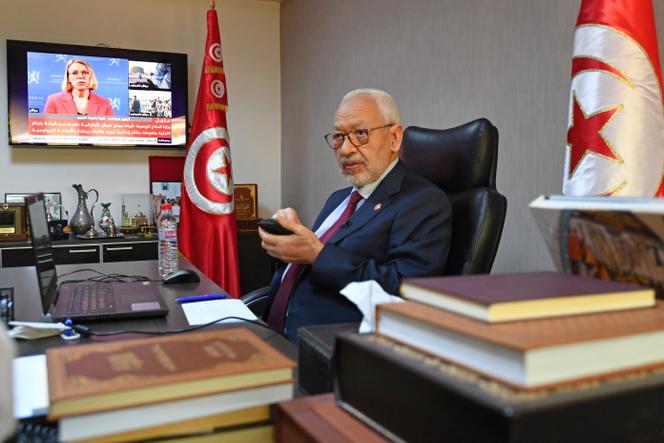
Rached Ghannouchi, leader of the Ennahdha party, has been sentenced to life imprisonment for participating in a terrorist organization. This judicial decision marks a major political turning point in Tunisia, eliciting mixed reactions and having profound implications for the country's future.
Life Sentence for Ghannouchi: A Political Turning Point in Tunisia
Political and Judicial Context
Tunisia has been experiencing increased political tensions for several years. The country, often presented as the only democratic success of the Arab Spring, has seen its political landscape reshaped by institutional crises. Rached Ghannouchi, a central figure in this transition, has embodied the moderate wing of Tunisian political Islam for decades. Founder and president of Ennahdha, a party classified as moderate Islamist, he played a key role in the post-revolutionary negotiations of 2011.
The accusations against him and several leaders of his movement date back to investigations opened in 2022. The Tunisian judicial authorities accuse them of having set up a parallel structure within the party. This structure allegedly functioned as a "secret security apparatus," according to the terms used in the indictment. The alleged facts span a period covering the years 2013 to 2021, during which Ennahdha held dominant positions within the institutions.
The trial, which opened in March 2026, took place in a climate of political polarization. Ghannouchi's defenders denounce the instrumentalization of justice for political purposes. His supporters highlight his role in stabilizing the country after the fall of Zine el-Abidine Ben Ali's regime. His detractors, on the other hand, associate him with authoritarian excesses and opaque management of public affairs.
Details of the Conviction
The Tunis Court of First Instance delivered its verdict on May 28, 2026. Rached Ghannouchi, aged 84, was sentenced to life imprisonment for "participation in a terrorist organization." This legal qualification, provided for in Article 31 bis of the Tunisian Penal Code, targets acts likely to undermine the security of the State. The judges upheld his responsibility for the creation and alleged management of a clandestine structure within Ennahdha.
Nineteen other defendants, all members or associates of the party, were also convicted. The sentences ranged from ten years imprisonment to life imprisonment. Among those convicted are former deputies, local officials, and Ghannouchi's advisors. The judges based their decision on testimonies, internal party documents, and audio recordings. According to the prosecution, these elements demonstrate the existence of a network responsible for monitoring and intimidating political opponents.
The defense immediately announced its intention to appeal. Ghannouchi's lawyers contested the legality of the procedure, citing formal flaws and bias on the part of the judges. They also highlighted the lack of direct material evidence linking their client to acts of violence. Tunisian law provides for a period of thirty days to file an appeal, which could prolong the procedure for several months or even years.
Reactions and Implications
The conviction of Ghannouchi has elicited mixed reactions in Tunisia and abroad. President Kais Saied, in office since 2019, welcomed a decision "in line with the rule of law." In a televised address, he reaffirmed his determination to fight against "networks of corruption and terrorism." His supporters, gathered within the populist movement Dignity and Freedom, organized rallies to celebrate the verdict. They see it as a victory against what they call a "mafia system" inherited from the democratic transition.
Ennahdha, for its part, denounced a "parody of justice." In a statement published on May 29, 2026, the party called on its supporters to "remain calm but determined." Several demonstrations took place in Tunis, Sfax, and Gabès, gathering thousands of people. The security forces carried out preventive arrests to avoid any overflow. The organizers of the rallies were placed in custody for "disturbing public order."
On the international level, reactions have been cautious. The European Union expressed its "concern" regarding respect for the rights of the defense. The United Nations High Commissioner for Human Rights called for an "independent review" of the trial. The United States, traditionally close to Tunisia, adopted a more measured position. The State Department reaffirmed its commitment to "stability and democracy" in the country, without explicitly condemning the verdict.
The political consequences of this conviction could be significant. Ennahdha, already weakened by internal dissensions, risks a split between moderates and radicals. Some party leaders might seek to negotiate with the current power to obtain concessions. Others, on the contrary, might harden their opposition, risking increased radicalization. Tunisian society, already divided, could see its fractures deepen.
Conclusion: Towards a New Political Era?
The conviction of Rached Ghannouchi marks a turning point in Tunisian political history. It is part of a broader dynamic of recentralization of power around the executive. Since 2021, President Saied has undertaken a reform of institutions, reducing the role of Parliament and limiting counter-powers. This judicial decision could accelerate this trend by further marginalizing opposition parties.
The coming months will be crucial for the future of the country. The appeal process, if initiated, could lead to new developments. An affirmation of the verdict on appeal would strengthen the position of the current power. Conversely, an acquittal or a reduction in sentences would restart the debate on the independence of the judiciary. In both cases, Tunisia seems engaged in a phase of political recomposition whose outlines remain uncertain.
Observers are questioning the country's ability to preserve its democratic model. The growing polarization between supporters and opponents of President Saied could weaken social balances. The next elections, scheduled for 2027, will be a test for the legitimacy of the institutions. Ennahdha, deprived of its historical leader, will have to reinvent itself to maintain influence. In this context, the conviction of Ghannouchi could well be the symbol of a Tunisia in search of a new social contract.
Key Points
- Rached Ghannouchi sentenced to life imprisonment for participation in a terrorist organization.
- The trial took place in a climate of political polarization and increased tensions.
- Reactions to the conviction are mixed, with major implications for Tunisia's political future.
- The defense has announced its intention to appeal, contesting the legality of the procedure.
- The conviction could accelerate the recentralization of power around the executive in Tunisia.
Sources
- Al Jazeera World - "Tunisian court sentences Ennahdha leader Rached Ghannouchi to life in prison". (secondary)
- Le Figaro - "Tunisia: Rached Ghannouchi, opposition figure, sentenced to life in prison". (secondary)
- Le Monde - "In Tunisia, Rached Ghannouchi, opposition figure and already incarcerated, has been sentenced to life imprisonment". (secondary)
Transparency: 3 sources (0 primary, 3 secondary). Verification: June 3, 2026.
Truthyx - June 3, 2026